Morning yoga for beginners can start with fifteen minutes of familiar movements, stable supports and pauses. You don't need to wake up at dawn, stretch intensely or do an entire Sun Salutation sequence. The best start fits your body and your schedule.
The alarm clock rings and the day seems to have started before you. Between messages, coffee and appointments, the desire to reserve a moment for yourself arises. A short yoga practice in the morning can act as that break: a time to get out of the automatic rush and realize how you want to start the activities. It doesn't need to transform your entire routine or produce an extraordinary sensation to make it worth it.
This guide presents a flexible structure for 15-minute morning yoga, with seated options, guidance for preparing the space, and ways to choose movements without overdoing it. The script organizes an educational experience; It is not a treatment for pain, fatigue or any health condition. If you don't yet know the basic positions, start with the Hatha Yoga guide for beginners and look for guidance to define your adaptations.
Why practice yoga in the morning?
The main reason for choosing morning time may be practical: perhaps it's the only time when the house is quiet or the schedule hasn't changed yet. For someone else, it will be the busiest period. There is no obligation to practice at dawn for a class to be legitimate. The schedule is an organizational resource, not a measure of dedication.
Some readers like to start the day by noticing supports and making simple movements before spending a lot of time sitting. Others prefer a pause of attention before making their first decisions. These preferences help define the purpose of the session, but do not demonstrate that the morning produces unique or superior benefits than other times.
Try formulating a concrete intention: I want to know two movements, I want to practice without looking at messages or I want to learn how to pause. It is easier to evaluate a proposal like this than to require fifteen minutes to solve all the day's challenges. A difficult morning can also end in a sensible choice not to practice.
Before you start: notice how you are today
Don't get out of bed directly into the widest position of a class. Make your usual transitions calmly and see if you are comfortable moving. If you tend to feel dizzy when standing up, follow the instructions you received from your healthcare professional. A yoga video should not replace individual advice on safe position changes.
Ask what is possible this morning. Did you get little sleep? Are there any new discomforts? About to leave late? This observation is not to find excuses, but to choose a realistic format. A three-minute sitting experience may be more appropriate than a hasty, divided-attention floor sequence.
When there is an injury, recent surgery, pregnancy or specific restrictions, confirm with those who follow your case which movements are permitted. O NCCIH highlights the need to adapt yoga to individual conditions. The word beginner in the class name does not guarantee that all proposals will be appropriate for you.
Prepare a simple space without turning everything into a chore
Choose a place where you can move around without bumping into furniture. Make sure the floor and carpet are dry and stable. Leave a firm chair nearby when it is part of your adaptations. If the practice will be seated, check the height of the seat and the support of the feet before following any movement.
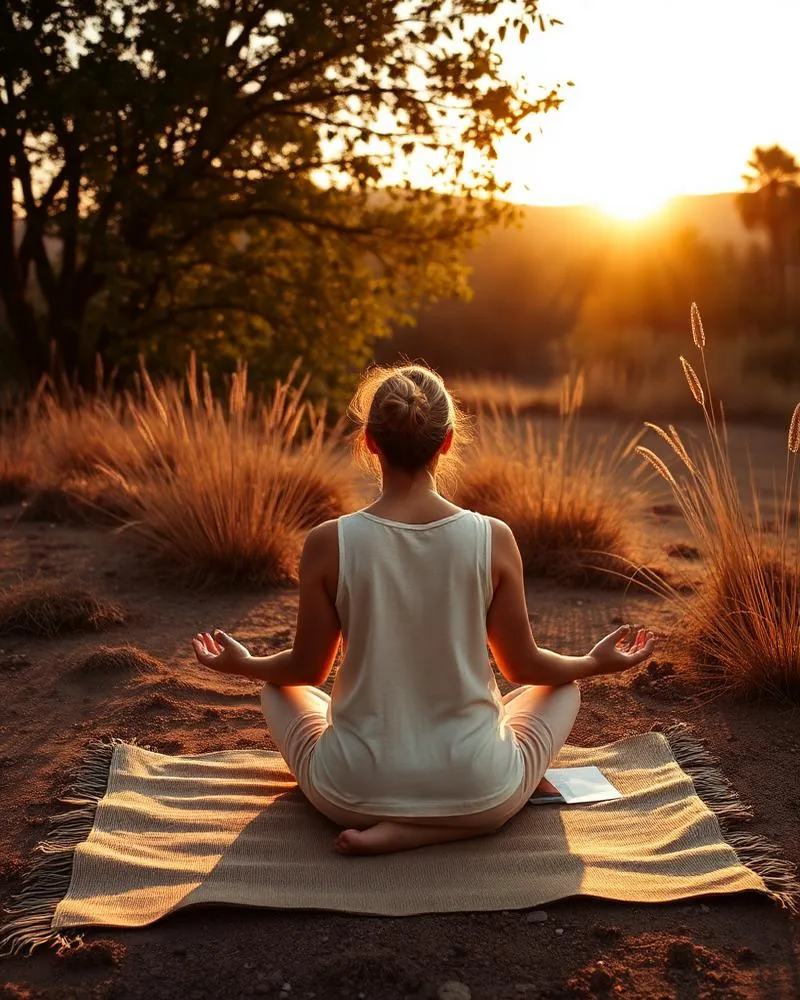
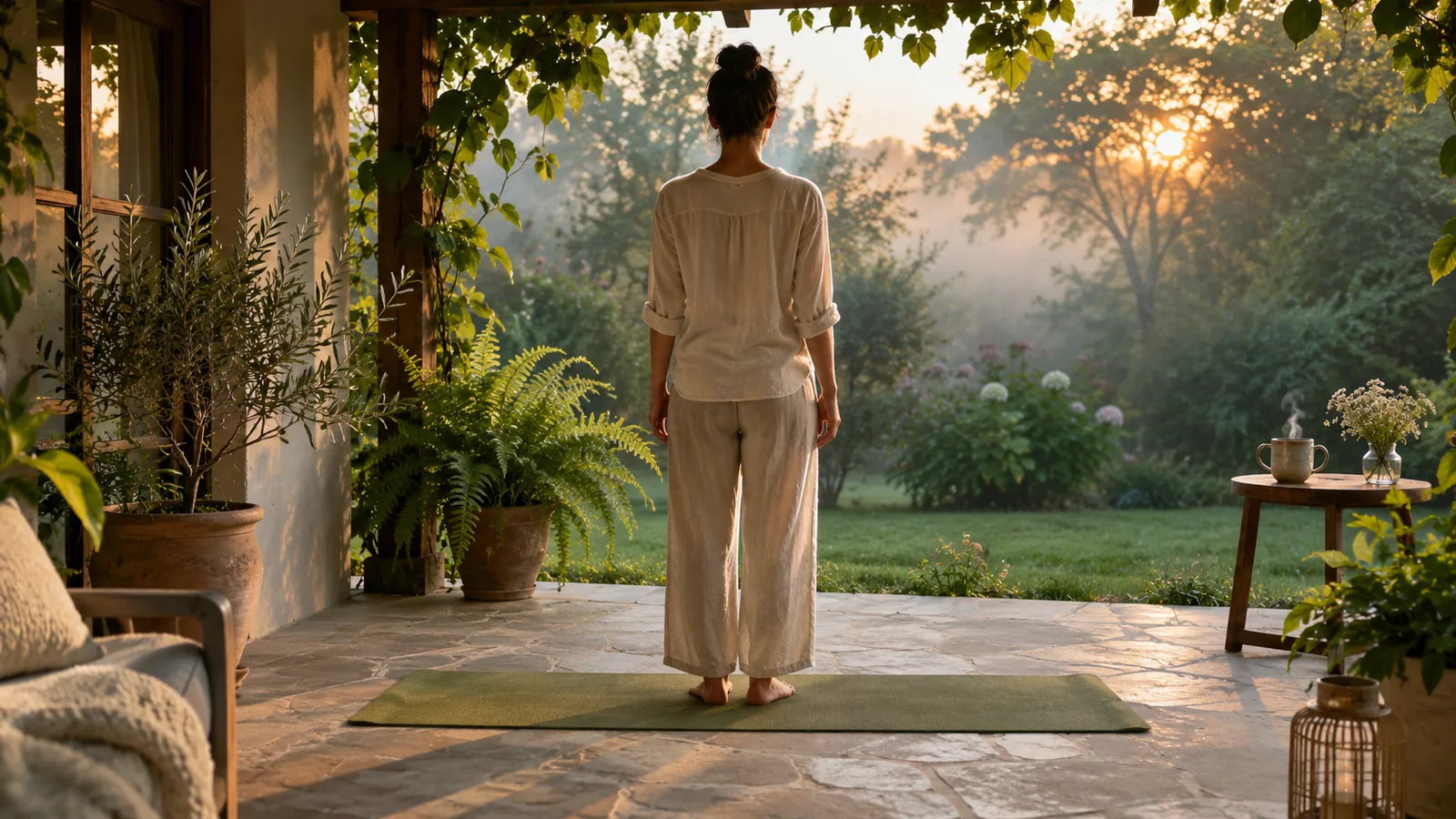
Open the curtain or turn on enough light to see the supports. A balcony can be nice, but it is not essential. Take into account temperature, sun exposure and wet floors. The cover scenario is illustrative: you don't need a silent garden to practice mindfully at home.
Separate what you actually use and leave other objects out of the way. A ritual that requires rearranging the entire room every morning can be difficult to maintain. Preparation can consist of one action: removing an object from the space or positioning the chair. Simplifying does not reduce care; can make care more viable.
A 15-minute morning yoga routine
The times below are organizational references, not an exercise dose or clinical prescription. You can modify the duration of any step. Choose movements that you already know and for which you have received sufficient guidance. If you are learning now, use the script as a topic for a conversation with the teacher, rather than trying to figure out a stance on your own from the description.
Check the supports, observe their arrangement and choose to sit or stand.
Alternate few known movements with pauses. Maintain a comfortable range.
Return to rest, notice your response, and transition into the rest of the morning.
Start with contact, not amplitude
Sitting or standing with appropriate support, observe where the weight finds support. Notice your feet, hands and shoulder position. You don't need to fix everything at the same time. Choose a small adjustment, such as better supporting your back, and see if the experience becomes more comfortable. Breathing can continue naturally.
If you prefer to keep your eyes open, choose a spot in front. Let your attention visit the body without demanding a specific sensation. A person may notice stiffness; another may just feel like getting started right away. Recognizing this starting point helps avoid a toss-up between the actual experience and the imagined ideal morning.
Try small hand and shoulder movements
Open and close your hands gently, maintaining support when necessary. Pause before repeating. Then, see if your shoulders can move a little and return to rest without excessive effort. There is no need to pull them back hard or perform large circles to feel like you have started the session.
If raising your arms is comfortable and permissible for you, explore a small height and return slowly. A teacher's demonstration might show hands above the head; your experience may end well before then. A smaller amplitude does not need to be compensated for with more repetitions or faster movements.
Include a known position of stability
Mountain Pose can be a reference for those who stand safely. The feet remain at a comfortable distance, the gaze finds a point in front and the arms rest. Use support when appropriate. If standing is not an appropriate choice, explore the same topic while sitting: how to distribute weight and reduce unnecessary strain?
Don't lock your knees or try to remain still like a statue. Small adjustments are part of the experience. You can compare how you feel with a slightly different foot position, always within a safe base. The focus is on perceiving and choosing, not on imitating a rigid form.
Make one transition at a time
If your class includes floor positions, allow time to get in and out of them in a way that is already safe for you. Don't speed up the transition to match the music or speech in the video. When in doubt, maintain an alternative sitting or standing position with support and ask for an individual demonstration at another time.
In your first yoga experiences upon waking up, it may be better to use a few positions at the same height. This reduces the need to repeatedly rearrange supports. The choice does not make the class any less complete: it leaves more space to learn how each movement happens.
Close before returning to tasks
Take a final moment to get into a comfortable resting position. Observe some contact and see if you want to adjust the practice on another morning. You can end with a practical intention, like eating your first meal without opening messages or organizing one appointment at a time. This choice is personal, without obligation to produce a profound change.
Finish with enough time to lift and put away the material without rushing. If the fifteen minutes always end in a rush, shorten the itinerary. Closing is part of the experience and can be more helpful than adding one last pose when you're already late.
How to adapt morning yoga to the chair
The seated version can maintain the same steps: arrive, explore and complete. Use a stable chair without wheels and find comfortable support for your feet. Your hands can rest on your thighs or on the arms of the seat. You do not need to support your torso away from the backrest if this causes fatigue or discomfort.
Choose small movements of your hands, ankles and arms, when appropriate to your case. The objective is not to reproduce every sitting position that appears on the mat. Some proposals need to be replaced, and others can simply be left out. For in-depth preparation, see our chair yoga guide for seniors and beginners.
If you accompany someone, explain one action at a time and respect the response time. Do not move the person's arms or head to get them into the desired shape. Ask if the support is comfortable and if she would prefer a break. Accessibility also depends on the quality of that conversation.
Do I need to do a Sun Salutation every morning?
No. The Sun Salutation is a well-known sequence, but it is not a requirement for practicing yoga in the morning. It brings together positions and transitions that may be demanding for some beginners. Starting with a part of the sequence or another script may be a better decision than trying to complete cycles quickly.
If you are interested in this chain, study our Sun Salutation guide and talk to a teacher about adaptations. Pay attention to the entrances and exits, not just the final positions. Do not increase the number of cycles as a way to compensate for a morning when you feel less energetic.
There is also no obligation to practice outdoors or look directly at the sun. The symbolic relationship of the sequence with light should not be interpreted as an instruction to expose the eyes. You can study their meanings and practice in a common space, with comfortable lighting.
Before or after breakfast?
There is no single rule that solves all routines. Observe what is comfortable and follow individual guidelines regarding medications, diet and health conditions. Don't skip a necessary meal or modify a treatment just to fit the practice into an ideal schedule.
For those new to the format, a brief, gentle session may be simpler to organize than an intense class. If certain movements bother you after eating, choose another time or talk to a professional. The purpose is to find a sustainable routine, not to test a dietary restriction associated with yoga on your own.
You can also divide the ritual: a seated break before starting the tasks and a class followed at another time. The day does not need to contain a single session that brings together movement, study, breathing and meditation. These experiences can be organized in different ways.
Where does breathing come into play in the morning practice?
In the introduction, breathing comfortably is enough. It is not necessary to use quick techniques to wake up or hold your breath to increase concentration. If a position makes you hold your breath, reduce the effort and look for an alternative. The quality of the practice does not depend on being able to control each air cycle.
Anyone who wants to study this topic specifically can go to pranayama for beginners. This deepening is different from adding a complex technique at the end of a video. Learning requires time, clarity and the possibility of interrupting the experience when you are not comfortable.
On a busy morning, you can alternate between paying attention to physical contact and a sound in the environment. Not everyone likes to observe their breathing, and this does not prevent a mindful practice. Choose a reference that helps you participate, rather than insisting on an instruction that increases your tension.
How to maintain the habit without turning the morning into a chore
Choose a simple clue: after opening the window, before turning on the computer or after organizing the first task. Leave the material in an easy-to-access location. Instead of promising a long streak every day, set a minimum version that makes sense when your schedule gets tight. This version may include just sitting and noticing the supports.
Evaluate the week together. If a certain schedule never works, change the schedule before concluding that you lack discipline. The article on daily yoga practice delves into the construction of regularity. Do not use practice records as a personal value scoreboard; they can just be a tool to recognize what is viable.
A missed session does not need to be made up with a longer class. Return with a familiar proposal. In periods of greater tiredness, you may prefer to know the restorative yoga at home. Changing the format can be a way to continue learning, not an abandonment of the initial intention.
Morning Yoga FAQs
Is fifteen minutes of yoga in the morning enough?
They may be sufficient for a short learning and attention experience. This does not mean that they meet all your physical activity needs or that they have a guaranteed clinical effect. Consider the content of the practice, your response, and the other components of the routine, with guidance as needed.
Can I practice right after waking up?
Make your usual transitions safely first and notice how you feel. If there is dizziness, pain or a condition that requires specific care, follow the individual recommendations received. You can choose a slightly later time. There is no need to get out of bed directly for a sequence of postures.
Does morning yoga need to be intense to get you in the mood?
No. A gentle proposal may suit the moment better, and the mood after practice varies. Avoid confusing tiredness produced by exertion with an obligatory sign of benefit. You can finish a simple session without sweating and still have learned something about movement and attention.
Do I need to practice fasting?
There is no universal rule that suits everyone. Consider comfort, dietary needs, medications and health advice. Do not alter important precautions to follow a generic recommendation found on the internet. A class can be adjusted to your schedule and conditions.
What to do when I wake up without feeling like it?
You can choose a smaller version or rest. If you want to try it, start with a familiar gesture and then decide if you want to continue. Avoid using practice as punishment for lack of motivation. The habit can be supported by flexible choices, without relying on constant enthusiasm.
A morning with presence does not have to be a perfect morning. Comfortable support and a small choice can already mark the beginning of your practice.
Sources and editorial context
General care must be deepened in Yoga: Effectiveness and Safety, from NCCIH. The fifteen-minute script is an original editorial proposal for organizing learning, not a validated clinical protocol. This guide integrates the trail Yoga at Home for Beginners, which brings together study paths with different objectives.